Local life · Coquitlam, British Columbia
Published
Coquitlam’s Barred Owls and the Hidden Cost of Rat Poison
Barred owls share Coquitlam’s treed urban landscape and are often easier to hear than to see. The city warns that rodenticides can reach owls through poisoned prey. Start rodent control with food and access prevention, and ask a licensed professional about persistent problems.
Facts checked
In this story
The other shift at work after dark
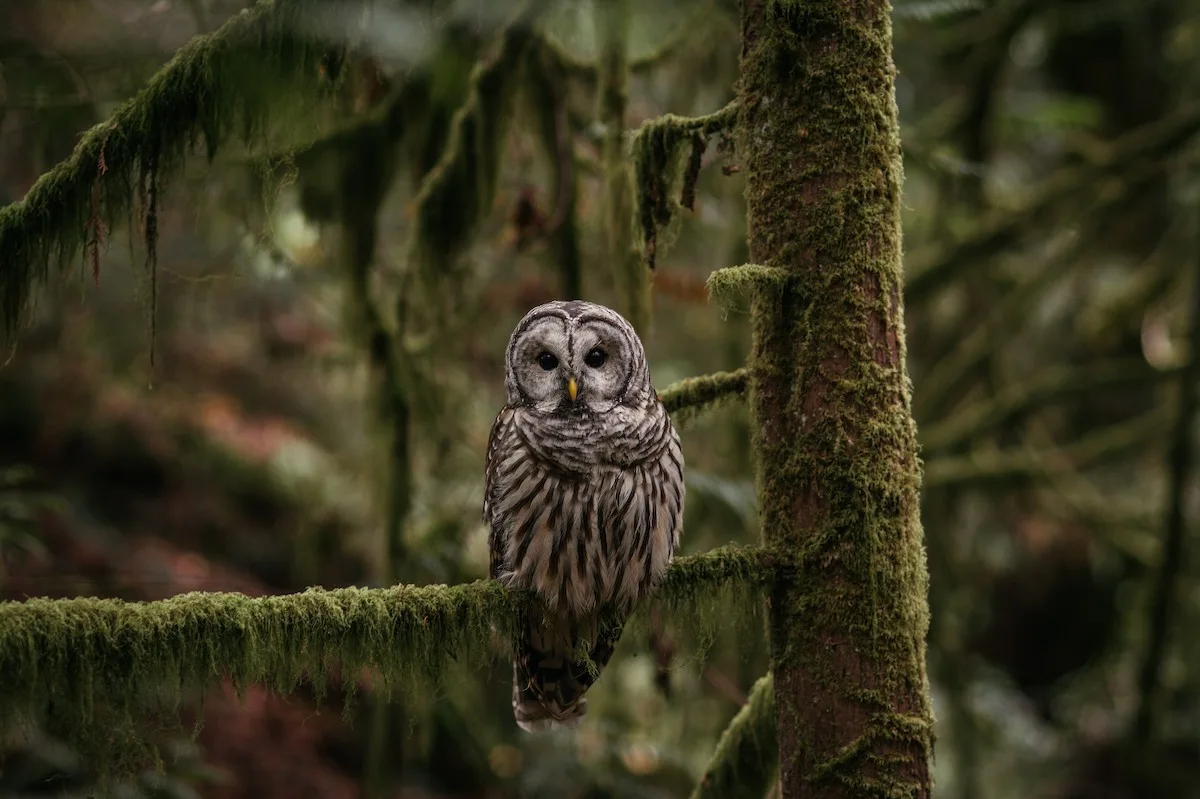
Coquitlam’s night life includes hunters who have no interest in a closing-time snack. A barred owl can sit quietly in a tree while people pass underneath, then cross a dark space with far less fuss than the traffic below it. The local bird photographed beside Nagano was a reminder that urban places carry another set of routines after dark.
The sighting does not prove that one restaurant frontage has a particular rat population, and the bird has not become an attraction with a reliable address. The interesting connection is broader: predators and people use overlapping places, often without the people noticing until a pair of large eyes appears in a photograph.
Barred owls are identifiable by their brown eyes, barred plumage and recognisable hooting pattern. They can be heard more easily than seen. That makes listening a satisfying way into the city’s wildlife, without making every encounter a pursuit for a closer image. The owl has no obligation to improve the view.
Source: A barred owl beside Nagano surprises local residents
Source: Cornell Lab: Barred Owl overview
Source: City of Coquitlam: rodent prevention and pesticide risks
The neighbour you hear before you see
Cornell’s bird guide describes the barred owl’s brown eyes, striped plumage and familiar hooting pattern, often represented as “Who cooks for you?” It also describes a bird that can pass quietly through trees or remain unnoticed on a branch. Missing an owl is not proof that there are none nearby. It may simply mean the owl is better at its part of the evening.
Residents’ stories of hearing calls without seeing the caller fit that experience. Listening is a useful way to become aware of local wildlife without turning every encounter into a close-up hunt. A distant bird need not be brought nearer to make the sighting count.
There is also a less comfortable wider context. Cornell notes that barred owls expanded into the Pacific Northwest and can displace threatened spotted owls. Enjoying one animal does not erase complicated conservation relationships. It is possible to find an individual owl beautiful without pretending every species interaction is a picture-book friendship.
Source: Cornell Lab: Barred Owl overview
Source: A barred owl beside Nagano surprises local residents
The household problem and the wildlife problem share a food chain
Rodent prevention is not simply a question of choosing a stronger product. Coquitlam recommends removing the food and entry opportunities that keep a problem returning: secure waste, collect fallen fruit, feed pets indoors and repair access to buildings. Those jobs are less dramatic than a poison box, but they address why rodents were attracted to the site in the first place.
The city warns that rodenticides can reach birds of prey through the rodents they eat. A resident need not identify the exact owl overhead to take that pathway seriously. If prevention does not resolve an infestation, ask a licensed pest-control professional about the actual site and methods. Protecting wildlife and refusing to tolerate rats in a kitchen are compatible aims; the work is in choosing a plan that addresses both rather than shifting the damage elsewhere.
Source: City of Coquitlam: rodent prevention and pesticide risks
A household choice can reach the tree outside
The practical local connection is pest control. Coquitlam warns that rodenticides can indirectly poison birds such as hawks and owls when they eat poisoned rodents. A product aimed at an unwelcome animal can travel beyond the place where somebody put it. The owl beside a restaurant makes that chain easier to imagine than a label in a hardware aisle does.
The city’s first steps focus on prevention: secure food waste, remove fallen fruit, feed pets indoors and repair places rodents can enter buildings. It also discusses control options and recommends a licensed pest-control business when problems persist. A resident dealing with an infestation deserves workable help, not a lecture implying that enjoying wildlife means tolerating rats in a kitchen.
Those two needs can coexist. The sensible goal is a home that does not feed or shelter rodents, alongside a neighbourhood where wild predators are not casually exposed to poison. Ask a qualified professional about the specific problem and methods rather than assuming the strongest-sounding product is the most complete solution.
Meanwhile, let the owl remain a pleasant surprise. Watch quietly, leave space and resist turning its location into a gathering that changes the encounter for the bird. The local pun has already done its work. The useful sequel is considerably less theatrical: better bins, fewer easy entry points and a city in which the night staff can keep getting on with the job.
Source: City of Coquitlam: rodent prevention and pesticide risks
Source: A barred owl beside Nagano surprises local residents
Source: A barred owl beside Nagano surprises local residents
Questions people ask
How can I recognise a barred owl?
Cornell’s guide describes brown eyes, a rounded head and barred plumage. Its characteristic hooting call can help reveal a bird that is difficult to see in the trees.
Source: Cornell Lab: Barred Owl overview
Is a barred owl the same as a barn owl?
No. Cornell lists them as different species. The local discussion included that identification confusion.
Source: Cornell Lab: Barred Owl overview
What does a barred owl sound like?
Cornell describes a distinctive hooting pattern commonly rendered as “Who cooks for you?”
Source: Cornell Lab: Barred Owl overview
Can an owl be nearby without being seen?
Yes. Cornell describes barred owls passing quietly through trees or resting unnoticed on branches.
Source: Cornell Lab: Barred Owl overview
Does one owl prove the area has a rat infestation?
No. The photographed sighting and a resident’s hunting comment do not measure a local rodent population.
Source: A barred owl beside Nagano surprises local residents
Can rodent poison harm owls?
Yes. Coquitlam warns of indirect poisoning when owls or other predators eat poisoned rodents.
Source: City of Coquitlam: rodent prevention and pesticide risks
What can I do before using rodent poison?
The city recommends reducing food, water and shelter and repairing access points to buildings.
Source: City of Coquitlam: rodent prevention and pesticide risks
Should I leave pet food outside?
The city advises feeding pets indoors and cleaning up leftovers to reduce rodent attractions.
Source: City of Coquitlam: rodent prevention and pesticide risks
Who can help with a persistent rodent problem?
Coquitlam recommends consulting a licensed pest-control company when problems persist.
Source: City of Coquitlam: rodent prevention and pesticide risks
Are barred owls free of conservation controversy?
No. Cornell notes their expanded western range and impacts on spotted owls. An enjoyable sighting is part of a more complex ecology.
Source: Cornell Lab: Barred Owl overview
Something changed? Tell us about a correction.