Local life · Coquitlam, British Columbia
Published
ƛ̓éxətəm Regional Park: Trails, Wildlife and the Former Colony Farm
Colony Farm was renamed ƛ̓éxətəm Regional Park in 2023. The name selected by Kwikwetlem First Nation means “to be invited”. Its trails cross a working habitat landscape, with cycling restrictions and closed areas that visitors need to respect.
Facts checked
In this story
A familiar view with an older story
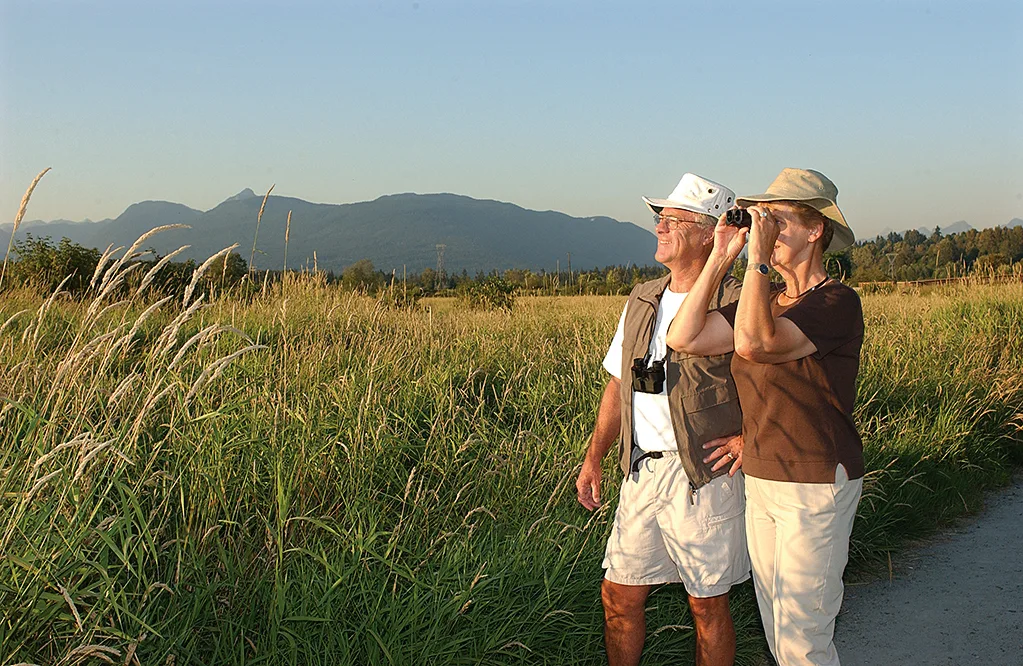
Some parks announce themselves with an attraction. This one makes a quieter offer: fields, birds, a river and enough room for a walk to stop feeling like a task. It is the sort of place people photograph on a family outing and then keep calling by the name they learned years ago.
The regional park is now ƛ̓éxətəm, pronounced tla-hut-um, a name selected by Kwikwetlem First Nation meaning “to be invited”. Metro Vancouver dates the change from Colony Farm to July 1, 2023. The meaning offers more than a new label for a familiar walking place: it acknowledges the relationship between visitors and the Nation’s traditional and ancestral territory.
The older name still appears in directions, community-garden records and people’s habits. A visitor may arrive knowing the fields and river but little about how the layers connect. A good walk begins by noticing that this is not empty land supplied for recreation. It has Indigenous history, a former institutional farm and present-day habitat whose needs do not begin at the car park.
Source: An early Mother’s Day visit to Colony Farm, visible yearly top feed
Source: Residents try to identify buildings near the river, April 2025
Source: Metro Vancouver annual report: the park’s name and welcome
Open land is not empty land
The former farm is another layer. Coquitlam’s parks history describes its early role supporting Essondale hospital, providing food and work, followed by the end of farming in 1983 and the transfer to regional park management in 1996. That history does not begin with public recreation, and the deeper Indigenous connection predates the farm.
Today’s brochure invites visitors to notice riverbanks, open fields and community gardens. A landscape that looks pleasantly untidy can be doing important work for wildlife. Habitat areas are not spare space waiting for somebody to make a shortcut, and a good bird photograph does not make a closed field a public path.
The community gardens add a particularly human rhythm. They are places where someone else has put time, patience and probably several arguments with the weather into growing something. Visitors may enjoy them from the paths. The vegetables are not a free sampling station, however convincingly a tomato may appear to be making eye contact.
Source: Coquitlam parks master plan: Colony Farm history
Source: Metro Vancouver: regional park visitor brochure, November 2024
A choice between looking closely and covering distance
The dyke trails favour a longer view across fields and water; the gardens favour a slower look at a worked landscape. Those are different pleasures and need not be combined into a grand circuit. A person watching birds may cover very little ground and still have a complete outing. A group wanting continuous exercise should plan a permitted route instead of discovering too late that the attractive shortcut is a protected habitat area.
The brochure makes those habitat boundaries explicit: designated wildlife areas are not open for ordinary public access. It also forbids removing vegetation and mushrooms. The community gardens cover three hectares, with visitors welcome on paths and produce left for the people growing it. That is a useful balance to bring to the whole park: invitation does not mean every part of the landscape is available for every activity.
Source: Metro Vancouver: regional park visitor brochure, November 2024
The same map does not give everyone the same route
Cyclists and walkers should read the route details separately. The visitor brochure distinguishes shared dyke routes from paths where cycling is prohibited. It also describes a disrupted cycling connection and sections where a bike must be walked. Because that brochure is dated November 2024, current signs and park alerts take priority over treating every line on it as a permanent guarantee.
Accessibility needs the same care. A broad dyke path may look simple in a photograph while including loose gravel, potholes or steeper sections. Garden paths can be grass. Choose the specific route for the people travelling with you, and contact the park operator about current conditions rather than assuming “flat park” answers every access question.
In November, plan the return before the light goes. Check the posted closing time at the entrance and allow for wet surfaces. Keep dogs leashed and out of protected habitat areas. If the purpose is to see wildlife, a slow look from the path is generally a better beginning than an enthusiastic pursuit across a field.
The old name will remain in conversations and older directions for a while. The newer one offers something worth carrying beyond a pronunciation lesson: an invitation is a generous thing, and good guests pay attention. That is a useful way to enjoy a place whose most interesting features were never built for our entertainment.
Source: Metro Vancouver: regional park visitor brochure, November 2024
Source: Metro Vancouver annual report: the park’s name and welcome
Find the park
ƛ̓éxətəm Regional Park
Colony Farm Road, Coquitlam, British Columbia
Use designated paths and respect protected habitat areas.
Source: Metro Vancouver: regional park visitor brochure, November 2024
More place details
Source: Compare these places in Resources
Source: An early Mother’s Day visit to Colony Farm, visible yearly top feed
Questions people ask
What is Colony Farm Regional Park called now?
Its current name is ƛ̓éxətəm Regional Park. Older maps and conversations may still use Colony Farm.
Source: Metro Vancouver annual report: the park’s name and welcome
How is ƛ̓éxətəm pronounced?
Metro Vancouver gives tla-hut-um as a pronunciation guide.
Source: Metro Vancouver annual report: the park’s name and welcome
What does the park’s new name mean?
It means “to be invited”, selected by Kwikwetlem First Nation.
Source: Metro Vancouver annual report: the park’s name and welcome
When was the park renamed?
The renaming ceremony took place July 1, 2023.
Source: Metro Vancouver annual report: the park’s name and welcome
Can I cycle on every park trail?
No. The brochure distinguishes shared routes from paths where cycling is not permitted. Check current signs and closures.
Source: Metro Vancouver: regional park visitor brochure, November 2024
Can visitors pick produce from the gardens?
No. Visitors should remain on paths and leave fruit, vegetables and flowers to the gardeners.
Source: Metro Vancouver: regional park visitor brochure, November 2024
Are dogs allowed off leash?
The visitor brochure requires dogs to be leashed and under control, with no dog access to wildlife habitat areas.
Source: Metro Vancouver: regional park visitor brochure, November 2024
Is every path wheelchair friendly?
No. Surfaces and slopes vary, and some garden routes are grass. Check the specific route and current conditions.
Source: Metro Vancouver: regional park visitor brochure, November 2024
Was the land really a farm?
Yes. The city’s parks history describes its farm role, the end of farming in 1983 and later transfer to regional park management.
Source: Coquitlam parks master plan: Colony Farm history
Can I enter a closed field for wildlife photos?
No. Keep to designated routes and respect habitat-area restrictions.
Source: Metro Vancouver: regional park visitor brochure, November 2024
Something changed? Tell us about a correction.